
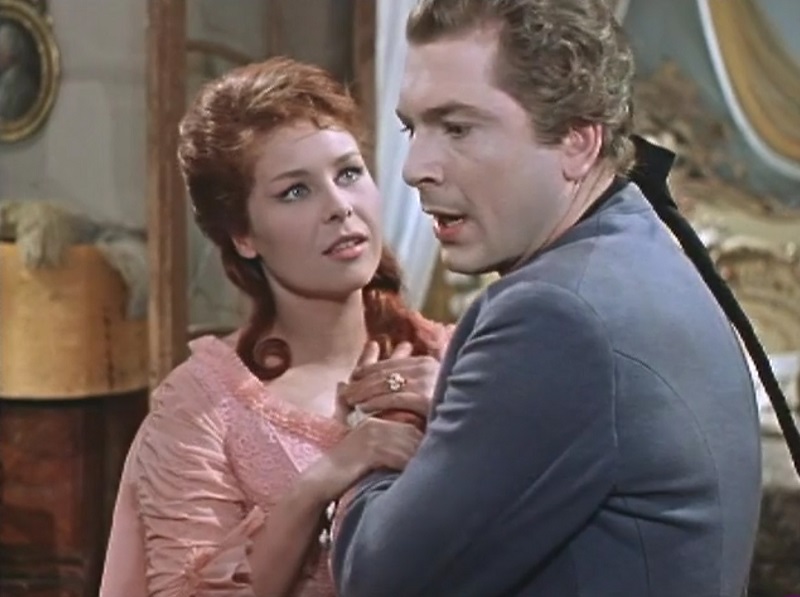
Not surprisingly, most of the films that came out of the DEFA studios in East Germany were concerned with the twentieth century, that being the century when old orders were overthrown in favor of various versions of Marxist philosophy. A few films went back as far as the late nineteenth century, but concluded with the Second World War. Films that went further back than that were almost always fairytale films and operas, but there were a few exceptions. One was Minna von Barnhelm, or the Soldier’s Fortune (Minna von Barnhelm, oder das Soldatenglück), which takes place in 1763, a few months after the Treaty of Hubertusburg ended the conflict between Prussia and Austria and brought the Seven Years’ War to a close.
The film follows the misadventures of Major von Tellheim (Otto Mellies), who used his estate to help finance the war and now finds that the king won’t honor the debt, leaving him in serious financial trouble. He was planning to marry Minna von Barnhelm of the play’s title (Marita Böhme), but now feels he cannot. Tellheim has been staying at a local inn, but loses his room to a lady and her chambermaid because he can’t pay the rent. The lady turns out to be Minna, who soon discovers that her beloved had sold his ring to help pay his debts. Tellheim does not want to marry Minna in poverty, and his pride won’t allow him to accept help from anyone. In an attempt to level the playing field, Minna pretends to be penniless as well. The deceptions on both sides are helped along by Tellheim’s faithful friend and war buddy, Sergeant-Major Werner (Manfred Krug), and Minna’s Chambermaid Franziska (Christel Bodenstein). Pretty soon, romance starts budding between the two accomplices.
The film is based on Gotthold Ephraim Lessing’s play of the same name. The play was immensely popular in Germany and has been filmed several times (usually for television). In Germany, it continues to be performed to this day. Goethe even performed in a production of it when he was young. Playwright Lessing was born in Kamenz, near Dresden. He was the son of a Lutheran minister, and he went to the University of Leipzig, where he studied theology, medicine, philosophy, and philology, which is a helluva course-load. There, he met Friederike Caroline Neuber, an actress of renown in Germany. Neuber enlisted Lessing to translate French plays into German for her. Lessing became fascinated with the form and soon was writing his own plays. Along with Minna von Barnhelm, many of these plays are still performed today, including Emilia Galotti, Nathan the Wise, and Miss Sara Sampson.
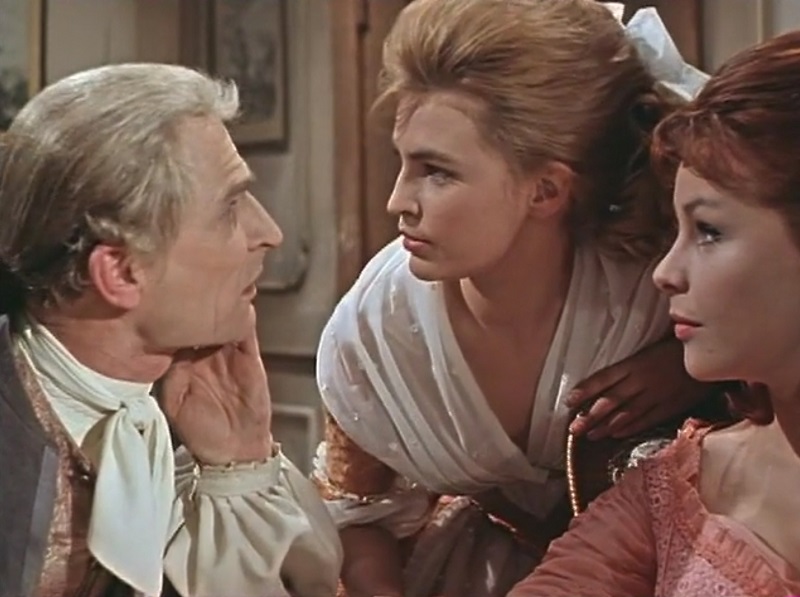
Almost all of the films Martin Hellberg directed were costume pieces, so it’s not surprising that Hellberg got his start in theater. Born in Dresden, Hellberg worked as a machinist until 1924, when he was hired by the Sächische Staatstheater in Dresden. He kept the job as general manager there until 1933, when Hitler came to power. Lessing was fired because he was a member of the German Communist Party. Thereafter, he held several jobs, often losing them because of his political beliefs. Like nearly every other able-bodied man in Germany, he was eventually drafted into the war effort. After the war, Hellberg went back to the theater. In 1952, he moved into films, directing The Condemned Village. Hel went on to direct several more films, including The Story of a Young Couple, The Ox of Kulm (Der Ochse von Kulm), The Judge of Zalamea (Der Richter von Zalamea), Emilia Galotti, and Shakespeare’s Much Ado About Nothing (Viel Lärm um nichts). After the Shakespeare film, Hellberg decided to hang up his director’s hat and work exclusively as an actor. His roles included Arturo in Pinocchio, Goethe in Lotte in Weimar, and the old professor in Mephisto. Hellberg was still working when the Wall came down, but he was already well into his eighties by that point. He died in 1999.
Playing the excessively proud Major Tellheim is Otto Mellies. Born in 1931, Mellies attended the drama school in Schwerin from 1947 until 1949 and began appearing on stage soon thereafter. He became a regular member of the company at the Deutsches Theater in Berlin and remained a member for fifty years. Mellies got his first movie role in 1955 in Sommerliebe (Summer Love), a minor East German rom-com. His first major role was in Martin Hellberg’s film adaptation of Schiller’s Kabale und Liebe (Intrigue and Love). The Wende had less effect on Mellies’ career than many of his fellow DEFA actors. After 1989, he continued to appear in films and TV movies, as well as providing the voice for the German dubs of everyone from Paul Newman to Christopher Lee.1 He died in 2020.
Manfred Krug turns in an entertaining performance as Tellheim’s trusty sidekick Werner (for more on Krug, see his Obituary). The character of Werner is based on Paul von Werner, a Prussian officer who gained fame for his bravery in the Seven Years’ War and later became the commander of Naugarten in Brandenburg. He died in 1785 and is buried in Toszek—now part of Poland.

As Werner’s love interest, Franziska, Christel Bodenstein is, if anything, too pretty. She takes over the screen every time she appears. This isn’t a knock against Marita Böhme, but Böhme’s beauty is thoroughly modern, and she looks out of place in eighteenth-century garb, whereas Bodenstein seems right at home here, perhaps thanks to her previous forays into fairytale films (see Midnight Revue for more on Christel Bodenstein). Interestingly, Böhme and Bodenstein each played the love interest for Manfred Krug twice in 1962. Böhme as his love interest in On the Sunny Side (her first movie) and Knock-Out (Der Kinnhaken—literally: “The Sock in the Jaw”), and Bodenstein in Minna von Bernhelm and Midnight Revue.
One of the most remarkable things about Minna von Barnhelm is its cinematography and lighting. The images are sharp and colorful. So sharp, in fact, that I began to think that the motion smoothing feature on my TV had somehow turned itself back on (it hadn’t).2 The camera chases the actors around, following them from room to room, and occasionally engaging in dizzying POV shots. It’s not surprising, then, that the cinematographer in charge was Karl Plintzner, one of the very best cinematographers at DEFA. He was also responsible for the colorful cinematography of The Singing, Ringing Tree, New Year’s Eve Punch, and The Golden Goose. It’s also not surprising that around this time, more portable Mitchell cameras (or Soviet knock-offs) were becoming available to the cinematographers at DEFA.
Reviews of Hellberg’s film were positive, with critics feeling he did justice to the play without tacking socialist dialectics onto it. In some respects, this play seems like just the type of romantic comedy that Hollywood would have been all over in the fifties. Likewise, it’s surprising that the BBC hasn’t turned this play into a TV movie.
1. It should be noted that Christopher Lee actually speaks very good German, but he does have an accent, which is the reason for the dubbing.
2. Motion smoothing, or motion interpolation, is a feature of HDTVs that is useful for getting a clear, blur-free picture when you’re watching football, but plays hob with the quality of a motion picture image. It is sometimes referred to as the “soap opera effect” because of its impact on an image. Movie people hate it. So much so that Tom Cruise recently appeared in a video with Mission Impossible – Fallout director Chris McQuarrie to tell people to turn it off when watching movies.


If you like what I do here and would like to let me know, you can buy me a cup of coffee by clicking on the button to the left.
© Jim Morton and East German Cinema Blog, 2025. Unauthorized use and/or duplication of this material without express and written permission from this site’s author and/or owner is strictly prohibited. Excerpts and links may be used, provided that full and clear credit is given to Jim Morton and East German Cinema Blog with appropriate and specific direction to the original content.
 East German Cinema Blog