
1973 was an interesting year in DEFA’s history. It’s not as historically important as 1966, when a dozen films were either pulled or shot down while in production, and it lacks the prodigious output of 1961, which saw the release of twenty-five films.1 But if you are looking for a year that is representative of most aspects of DEFA, 1973 is a good place to look. It is the year that saw the first appearance of all-American Dean Reed in an East German film (Aus dem Leben eines Taugenichts), and the release Heiner Carow’s ground-breaking The Legend of Paul and Paula. In terms of genre films, it saw the release of a musical (No Cheating, Darling!), a fairytale film (Susanne and the Magic Ring), a Western (Apaches), a biopic (Copernicus), and a literary adaptation (Unterm Birnbaum). Just for good measure, the year ended with one film getting banned for the usual stupid reasons (The Dove on the Roof). The only things really missing from that line-up are a spy movie and a science fiction film.
The Second Life of Friedrich Wilhelm Georg Platow (Das zweite Leben des Friedrich Wilhelm Georg Platow) is a tragicomedy of the type Germans were so good at making at UFA before Hitler came along, which is to say, bitterly comedic. It goes through the entire life of the title character, from his birth to his later years, but it’s mostly concerned with what happens to a man when his job has been made redundant, and he’s faced with finding a new occupation at a time when everyone thinks he’s past his expiry date.
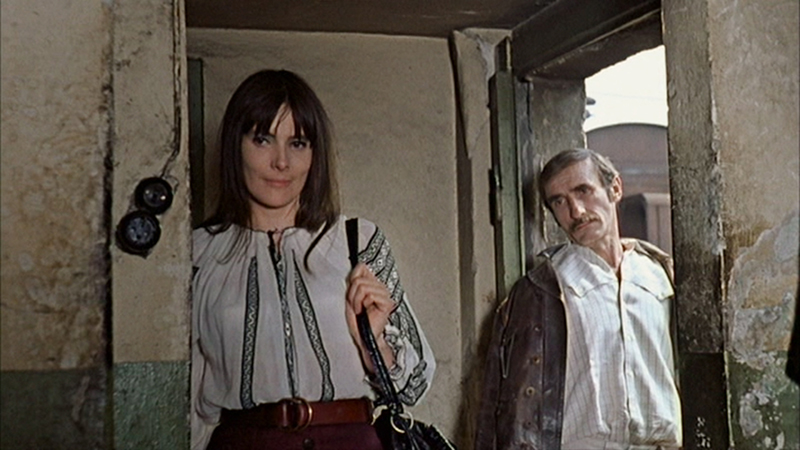
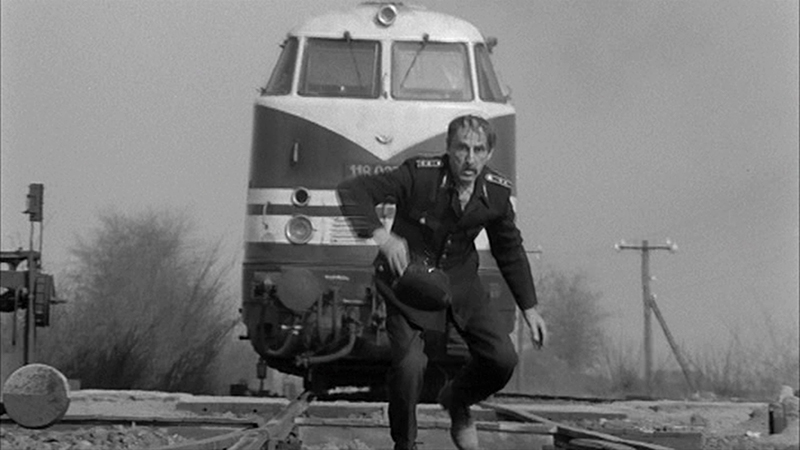
Friedrich Wilhelm Georg Platow has had a good life working at a railroad crossing in a small German town. It’s a mundane job, but Platow is a man of limited ambition, so maintaining a railroad crossing is fine with him. When technology makes his job redundant, Platow and his son—Georg Wilhelm Friedrich Platow—are given an offer: The son will go back to school for further training, and the father will take over the son’s job. But the son has the same “I’d prefer not to” attitude as his father, so Friedrich decides to take Georg’s place at the school. The only problem is that Friedrich is too old to apply for the job, so he buys a leather jacket and pretends to be younger. On the train to the academy, he meets Malvine, a heartbroken young woman who immediately guesses his age and then gives him pointers on how to appear younger. Throughout the film, an old lady and her grandson show up to make comments, eventually acting as a sort of two-person Greek chorus.
The Second Life of F.W.G. Platow uses film stock in an unusual way. Everything is in color except for the scenes where Platow (and, in one case, his son) are either working or involved with co-workers. Those scenes are in black-and-white. Thus, Platow’s childhood (which is where most directors would use black-and-white), his internment on the Eastern Front, and his time at the academy are all in color. Perhaps this is to indicate the drab nature of the jobs, or to show the simpler, black-and-white nature of a daily routine. It works either way. The one exception to this is the scene where Malvine’s backstory is revealed. This scene is also black-and-white. Is the filmmaker suggesting that her previous life was a job? Or was it simply to separate the scene from those that come before and after it?
The film is directed by Siegfried Kühn, a talented director who also gave us The Actress. He started his adult life as a mining engineer, but changed careers during a stay in Berlin. Kühn made up for lost time, plunging into his film studies with a fervor, studying at the film school in Babelsberg and under Sergei Gerasimov at the Moscow Institute of Cinematography (renamed the Gerasimov Institute of Cinematography in 1986). Kühn was not a particularly prolific filmmaker, and it would be five years after graduating from the film school in Moscow before he’d start working regularly for DEFA, working in theater at first, where he further honed his skills working with actors. Kühn hit his stride as a director around the time that the Wall came down, which brought his career to a screeching halt, from which he never recovered.
To cast the film, Kühn turned to East Germany’s theater community, hiring noted theater director Fritz Marquardt to play Platow. Marquardt was no stranger to film, having already appeared in smaller roles in The Falcon’s Trail, Time of the Storks, and The Man Who Replaced Grandma, but it was his role as a director at the Volksbühne, Berliner Ensemble, and various other theaters for which he is best known. More recently, he turned in a brief appearance as the bedridden father of the main character in Andreas Dresen’s Whisky with Vodka (Whisky mit Wodka).
Playing the cynical but sympathetic Malvine is Gisela Hess in her only theatrical film appearance. Aside from a couple of television show appearances in East Germany, Hess has spent her career on stage at Theater Magdeburg. In 1982, her sister was sentenced to two years and eight months for trying to immigrate to West Germany without exit papers.2
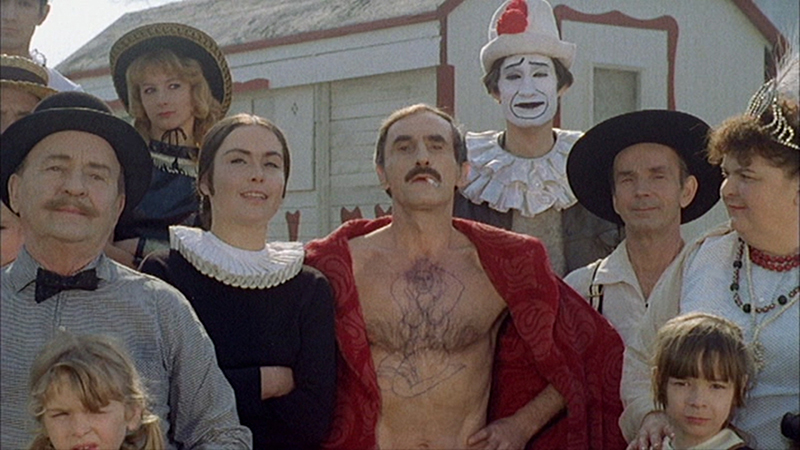
The film has a solid cast all the way down the line. The popular actor Fred Delmare plays Platow’s father, Platow’s son is played by Lothar Warneke, a fine director in his own right, and Winfried Glatzeder of Paul and Paula fame makes a brief appearance as a clown.
The soundtrack is by Hans Jürgen Wenzel, who worked as a conductor for various theaters and orchestras. He only composed music for seven films. The Time of the Storks was his first. The Second Life of F.W.G. Platow was his second. In 1976, Wenzel founded the Komponistenklasse Halle (Composers Class Hall), a training program for young musicians that is one of the few cultural programs from East Germany still in operation. He was a fan of expressionistic music, which the score for this movie hints at. It starts with an electric guitar, which is quickly replaced by an orchestral theme. It isn’t long, though, before the electric guitar is back, now more distorted than before, taking over the theme from the violins. It’s one of the cleverest movie themes around, sonically demonstrating the conflict between the old and the new.
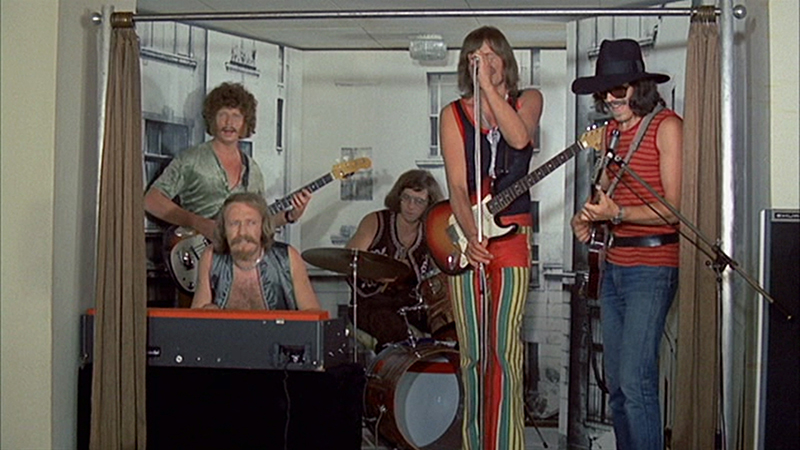
The East German rock band The Puhdys also appears in the film, playing at a restaurant. Earlier the same year, they had made a big splash with the soundtrack for The Legend of Paul and Paula. Here, they get to demonstrate their hard rock chops, playing much more aggressive music than the lilting themes from Paul and Paula.
The film caused some grumbling among the SED officials who reviewed it. They felt that it wasn’t a fair representation of the working class. The film was released without a premiere and was excluded from export. It wasn’t shown in unified Germany until 1996, and has had only limited screenings in North America since then. For this reason, the film remains relatively unknown, even in Germany. But don’t let its relative obscurity fool you—it is worth searching out. It is a genuine East German classic.
1. There was actually one more film intended for release that year: The Robe, but it was banned for its references to a walled city run by an idiot king.
2. Here in the West, this would normally be characterized as “fleeing” or “escaping,” but I’m intentionally avoiding such loaded terms. The fact is, many people were leaving East Germany around this time. That’s not to say the East German government was making it easy to emigrate, but it could be done, as Manfred Krug, Nina Hagen, Armin Mueller-Stahl, and other demonstrated.


If you like what I do here and would like to let me know, you can buy me a cup of coffee by clicking on the button to the left.
© Jim Morton and East German Cinema Blog, 2025. Unauthorized use and/or duplication of this material without express and written permission from this site’s author and/or owner is strictly prohibited. Excerpts and links may be used, provided that full and clear credit is given to Jim Morton and East German Cinema Blog with appropriate and specific direction to the original content.
 East German Cinema Blog