When it came to telling the truth about the American West, the East Germans had it all over Hollywood. While Hollywood was still portraying Indians as brutal savages, DEFA’s Indianerfilme gave a much more accurate picture of the events, showing that most of the wrongs were committed by the whites who felt that they had a right to the land just because of their skin color and religion. When Hollywood finally did get around to addressing the plight of the Indians in Cheyenne Autumn, they hired John Ford to direct it; a man who did more to defame the reputation of the Indians than any other filmmaker. As one might imagine, the resulting film was a limp effort, redeemed mainly by William H. Clothier’s spectacular cinematography. It wouldn’t be until the 1970s, with films such as Little Big Man and Soldier Blue, that American movies would finally take a good, hard look at the actions of the United States during the 1800s.
After the box office success of The Sons of the Great Bear and Chingachgook, the Great Snake, DEFA decided to continue to explore the subject of the American Indians. While those first two films were based on books, The Falcon’s Trail (Spur des Falken) is an original story. It’s also closer to a traditional Hollywood Western than either of those films. It has Cowboys and Indians, the U.S. cavalry, the pretty young miss visiting the West for the first time, a honky-tonk, a journey on a steam train, and a music score right out of The Big Valley, but the perspective is turned on its head. When the Indians attack the railroad train, we see it from the Indians’ perspective and root for them. When the cavalry comes charging to the rescue, it’s not a good thing. The film is a dizzying experience for those of us who were raised in the 1950s, when the only good Indian was Tonto.

As would be the case with several of the DEFA Indian films, the story is based on actual events that occurred in 1876. In 1868, the United States signed the Fort Laramie Treaty, exempting the Black Hills from all white settlement forever. Four years later, gold was discovered there, and prospectors descended on the area. Instead of enforcing the treaty, the government reneged on it, taking the land back and turning it over to the settlers.1
As one might imagine, the Indians were not amused. What followed was the Great Sioux War. An exact date for the events in the movies is not given, but the story appears to have taken place shortly after the Battle of Little Bighorn, but before the war was over. Much of what is shown here is factual. The Indians were indeed kicked out of the lands that had been previously allotted to them because white settlers found gold there, and it’s also true that buffalo were killed by the millions for the specific intent of robbing the Indians of their primary source of food. In the end, the United States took back almost all the land it had promised to the Sioux Nation, and arguments over this continue to this day.
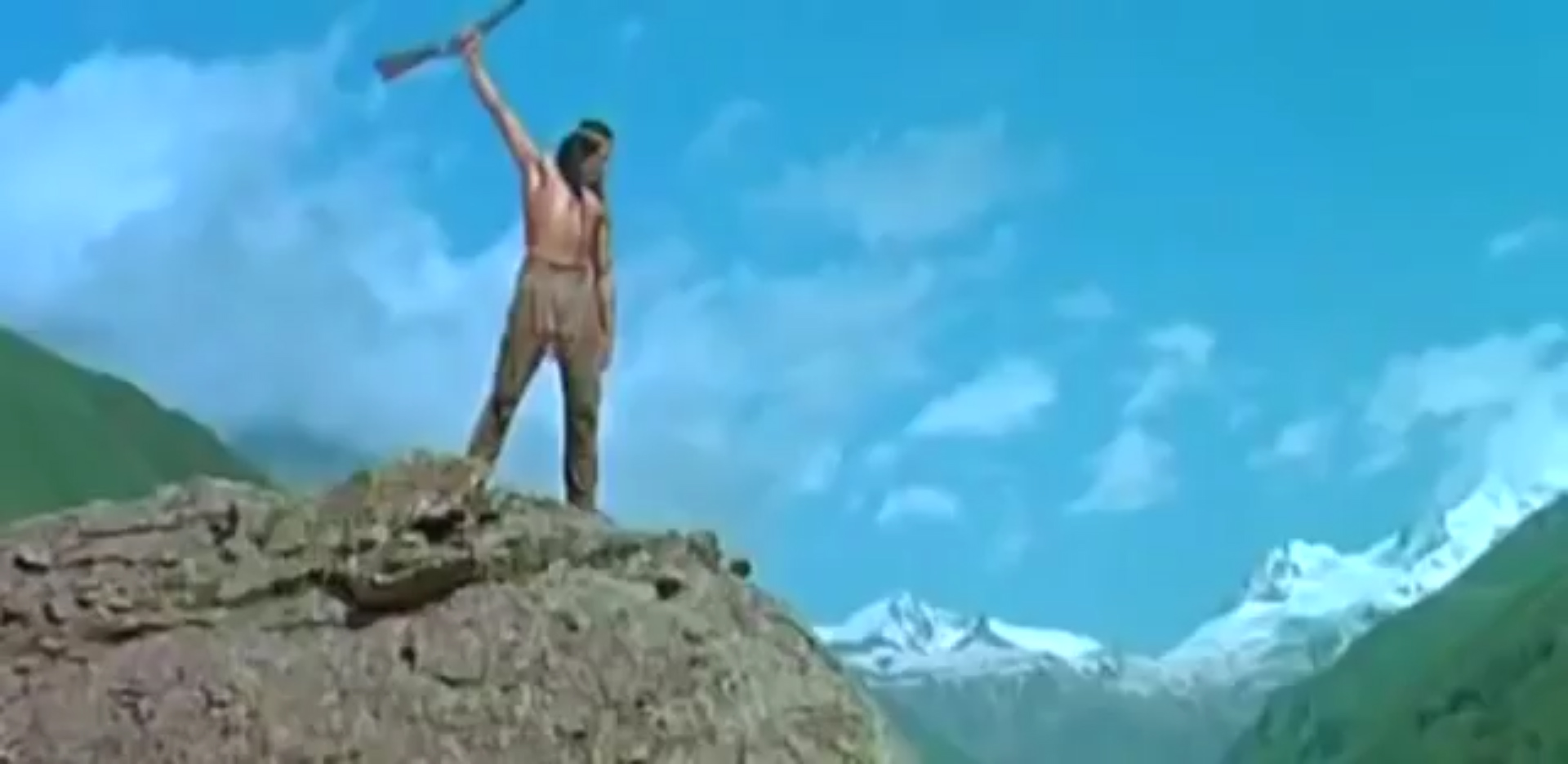
Playing Farsighted Falcon, the leader of the Indian renegades, is Gojko Mitić. As discussed elsewhere on this blog, Mitic was DEFA’s number one Indian. Mitić, born in Serbian Yugoslavia, got his start as a stuntman in Westerns made by various European production companies. With his black hair and good looks, it was only a matter of time before a director noticed him and gave him a speaking role.
In The Falcon’s Trail, Mitić gets to take full advantage of his stuntman background, running along the top of a moving train, scrambling up rocky hillsides, and riding bareback. As usual, Mitić’s voice is dubbed. Mitić speaks very good German, but with a slight Serbian accent, so he is usually dubbed for the Indianerfilme. Here, he is dubbed by Karl Sturm. Likewise, Polish actress Barbara Brylska, who plays the young Miss Emerson, is dubbed by Annekathrin Bürger. Also worthy of mention is the supporting cast, with Hannjo Hasse and Rolf Hoppe playing a couple of particularly nasty villains, and Helmut Schreiber and Fred Delmare as good guy counterparts.

Standing in for the American West is the Caucasus of Georgia, and standing in for a Union Pacific train was a specially prepared train and locomotive made by the “Karl Marx” Locomotive company in Babelsberg (Lokomotivbau Karl Marx). Those knowledgeable about trains and the Black Hills area of South Dakota will spot the differences, but they act as passable stand-ins here.
Costumes are by Günter Schmidt, who, having already done the costumes for The Sons of the Great Bear and Chingachgook, was well on his way to becoming the go-to designer for nearly all of the Indianerfilme. The music is listed as being composed by Wolfgang Meyer and Karl-Ernst Sasse. I’ve discussed Sasse at length elsewhere on this blog (see Her Third), but Wolfgang Meyer is a new name. The Falcon’s Trail shows up as his only feature film score. There are some noticeable differences between the music in this film and the music from the other Westerns in the DEFA catalog. Of all of them, this one sounds the most like an American Western, which may be one of the reasons why Meyer didn’t contribute to more films. DEFA was occasionally (depending on the period) relentless in its avoidance of Hollywood clichés.
Like the previous two Indianerfilme, The Falcon’s Trail was a hit at the box office, and was the first of the East German westerns to spawn an actual sequel—White Wolves (Weiße Wölfe), which was released a year later. On an amusing side note, the title of this film is the same as the German title for one of the best-known films of all time: The Maltese Falcon.
1. It’s one of history’s cruelest jokes that the popular expression for someone taking back something they gave a person was “Indian giver.” The expression has finally fallen out of fashion, but it still lingers. For an in-depth examination of the term, see NPR’s report on the subject.


If you like what I do here and would like to let me know, you can buy me a cup of coffee by clicking on the button to the left.
© Jim Morton and East German Cinema Blog, 2025. Unauthorized use and/or duplication of this material without express and written permission from this site’s author and/or owner is strictly prohibited. Excerpts and links may be used, provided that full and clear credit is given to Jim Morton and East German Cinema Blog with appropriate and specific direction to the original content.
 East German Cinema Blog
Good review….makes me want to go out and see The Falcon’s Trail and the original Indianerfilme. Where do you find these movies??
Thanks. A few are available with English subtitles from the DEFA Film Library. Nearly all are available without subtitles from Icestorm in Germany, including several that are now available on Blu-Ray. If your German is passable, you can sometimes find subtitles online and meld them to your copy of the film. You can also convert the subtitles to English, although you’ll probably end up with a lot of gibberish even in the best of circumstances.
The tarted-up steam locomotive was parked on a siding in Babelsberg in June 1969 when I arrived in Berlin. I could tell that someone had been making a Western, as it had a cowcatcher, a woodburner smokestack, and wood stacked so as to obscure the coal in the tender. It also had German couplers and buffers.
Also parked there were some pre-WWI German passenger cars with red crosses painted on white, presumably for a WWI story.