

In 1978, director Herrmann Zschoche’s film Seven Freckles was a huge hit. That film told the story of two young lovers meeting and falling in love at a summer camp, where they’re cast as Romeo and Juliet in a camp production of Shakespeare’s play. Eleven years later, Zschoche returned to the subject of young love, but with a different take. Just Married (Grüne Hochzeit) is Zschoche’s counterpoint to Seven Freckles. If the first film leads us down the garden path, the second one turns the hose on us. While not a direct sequel to the earlier film, Just Married immediately lets us know where it’s going by starting with a scene from Seven Freckles, then panning back to show us that we are in a cinema watching that film. Susanne (Anja Kling) and Robert (Marc Lubosch) are a young couple who are enraptured by the movie and decide they want their love to be just like the love in Seven Freckles. They have sex, and Susanne immediately gets pregnant. She doesn’t want an abortion, and she doesn’t want her child to be born out of wedlock. They get married, and things start going off the rails shortly thereafter.
Herrmann Zschoche had a knack for creating the kind of movies we now call “young adult” films. He understood the solipsistic angst that rules the heart of every teenager. He understood it better than any other director in East Germany—better than most Hollywood directors, for that matter. Zschoche’s interest in moviemaking went back to high school, where he was a member of the film club. After graduating, he started working as a cameraman while pursuing a degree in directing at the Film Academy in Babelsberg (Filmuniversität Babelsberg). He began directing in the early 1960s and was kept busy until his 1965 film Karla was banned in post-11th Plenum nonsense. It would be a few years before Zschoche was allowed to direct again. When he was, he began directing all manner of films, from the road movie Long Roads – Secret Love to the romantic comedy Fire Below Deck. He first explored young love in his 1974 film Love at 16, which could be seen as a precursor to Seven Freckles and Just Married. Other films by him about young people include Next Year at Lake Balaton and Swan Island. After the Wende, as with many other East German film people, his career was relegated to television, where he did well, directing several episodes of the popular TV shows Drei Damen am Grill (Three Ladies at the Grill) and Kurklinik Rosenau (Spa Clinic Rosenau).
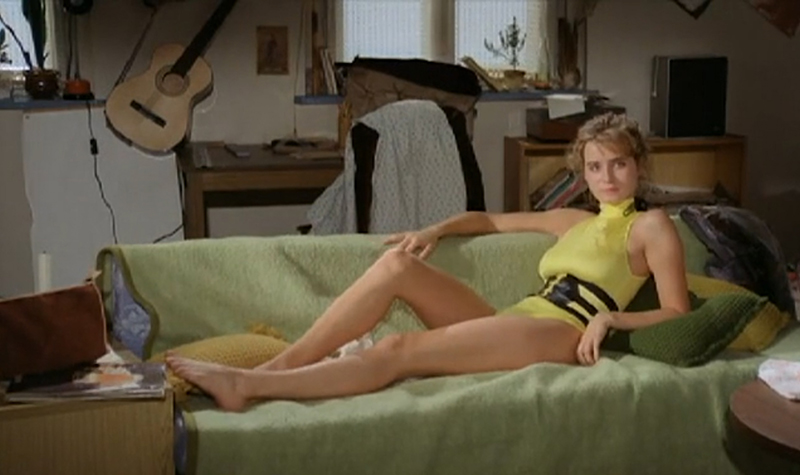
Anja Kling had appeared in a couple of movies before Just Married, but Zschoche’s film was her first starring role. As a child, Kling had wanted to be a doctor and had started preparing for a career in medicine when her older sister Gerit, who had already established herself as an actress, talked her into attending an open casting call. She got the part and has been acting ever since. Five days before the Wall opened, Gerit and Anja fled East Germany via Czechoslovakia. She had started studying acting at the Ernst Busch Academy of Dramatic Art (Hochschule für Schauspielkunst Ernst Busch) when she was offered the lead role in the miniseries Hagedorns Tochter (Hagedorn’s Daughter). For her performance, she won the Golden Camera for “Best Young Actress” (similar to the Emmys). She went on to win several more awards, including another Golden Camera for The Final Days (Wir sind das Volk). More recently, she’s been seen playing the put-upon Frau Dr. Schmitt-Gössenwein in the popular Help I Shrunk My… (Hilfe, ich hab meine … geschrumpft) films. She has also done dubbing work, voicing popular American actresses, such as Maya Rudolph, Tina Fey, Sandra Bullock, and many others.
Marc Lubosch also has had a long career in film and television, although not in front of the camera. He got his start as an actor, playing one of the kids in Jörg Foth’s The Arctic Sea Calls. His first starring role was in Michael Kann’s 1987 film, Stielke, Heinz, fünfzehn… (Stielke, Heinz, fifteen). Just as the Wall came down and East Germany was collapsing, Lubosch was finishing up his studies at the Film and Television Academy of the GDR (Hochschule für Film und Fernsehen der DDR). He appeared in a couple of small roles after Wende but has primarily worked as a gaffer since 2004.

The score is by Günther Fischer, who, by this time, had written the music for dozens of DEFA films. It’s an interesting score that uses a distorted electric guitar alongside a clarinet (or maybe a cor anglais, but since Fischer played the clarinet, it’s the likely candidate). It’s not a combination you’re likely to find in a score by Karl-Ernst Sasse, or any of the other classically-trained composers. However, coming from a pop band background, Fischer was more likely to see the electric guitar as a viable instrument in an orchestral composition (for more on Fischer, see The Solo Sailor).
Just Married isn’t as happy-go-lucky as Seven Freckles, but it isn’t as grim as Heiner Carow’s Until Death Do Us Part either. Zschoche is a careful technician, which is both a good and a bad thing. The use of the balcony on the dilapidated old building is clever if obvious, but the close-ups of the stained glass doorway panel let us know well in advance that, at some point, the thing will be broken. Its message is a good one: Real love is work, and a successful marriage is hard work. The film wasn’t the hit that Seven Freckles had been, with either the audience or the critics. Coming as it did near the end of the GDR’s existence, it does provide a good glimpse at East German life and fashions in the early eighties.


If you like what I do here and would like to let me know, you can buy me a cup of coffee by clicking on the button to the left.
© Jim Morton and East German Cinema Blog, 2025. Unauthorized use and/or duplication of this material without express and written permission from this site’s author and/or owner is strictly prohibited. Excerpts and links may be used, provided that full and clear credit is given to Jim Morton and East German Cinema Blog with appropriate and specific direction to the original content.
 East German Cinema Blog