

Don’t Forget My Little Traudel (Vergesst mir meine Traudel nicht1) is the story of Gertraud (“Traudel”) Gerber, A 17-year-old whose mother died in the Ravensbrück concentration camp eleven years earlier. Since then, Traudel has been living as an orphan, but she still carries around her mother’s last letter to her, which ends with the sentiment that serves as the title for this movie. The story starts when Traudel escapes from the orphanage and heads for the big city—Berlin, in other words.
Up until this point, director Kurt Maetzig’s films had been serious affairs, often focusing on the socialist values that spawned the DDR, but sometimes too didactic for their own good. In this film, he turns away from all that. This is not to say the principles of good socialism aren’t discussed here, but they don’t dictate the story in the same way that they did in Maetzig’s previous films. This time he goes for comedy, sometimes rather broadly, and even manages to throw in a parody of Marilyn Monroe’s famous skirt-lifting scene in The Seven Year Itch, when Traudel gets her fancy new shoes stuck in a ventilation grate.

After escaping from an orphanage in a remarkably risky-looking escape scene (filmed in one continuous shot, lest there be any doubt that the lead actress actually performed the stunt), Traudel is nearly run over by Wolfgang, a high-strung teacher on a motorcycle. She follows him to Berlin and settles in with him and his roommate, Hannes, who also happens to be a policeman. After Hannes unwittingly helps Traudel get new identity papers, he finds out who she really is, but by then, he’s in too deep.
Traudel is a bit of a train wreck. After years in the orphanage, the world offers too many temptations for the young woman who apparently lacks the common sense gene. With nothing to hold her back, Traudel goes from one messy situation to another. Hannes does his best to try and keep her below the radar, but that’s not Traudel’s style. This is a comedy, so, of course, everything gets happily resolved in the end.
Playing the impetuous Traudel is Eva-Maria Hagen. Before working on this film, Hagen had been acting on stage with the Berliner Ensemble. In 1954, she married the screenwriter Hans Oliva-Hagen, best known for his work on Carbide and Sorrel. Together they had one child—Catharina, better known today as Nina Hagen. Eva-Maria Hagen jumped right into starring roles in her first year working for DEFA. Although Don’t Forget My Little Traudel was the first film she worked on, it was released a couple of weeks after Track in the Night. Hagen was an immediate hit with the public, and her sexy good looks led her to become known as the “East German Brigitte Bardot.” Although dark-haired in reality, she often appeared as a blonde in films.
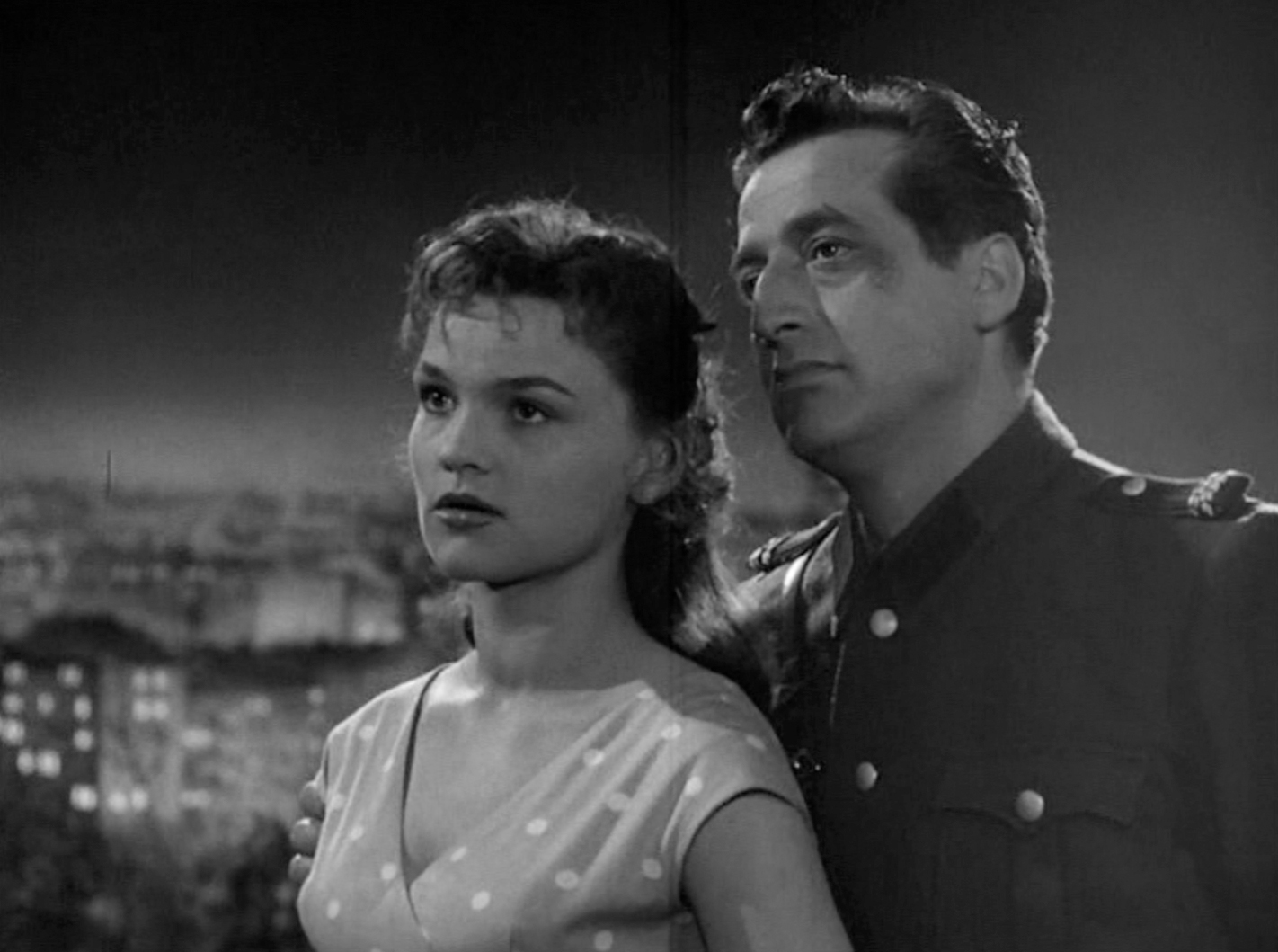
In 1965, she met the singer-songwriter Wolf Biermann, and the two became an item. By this time, the SED (East Germany’s ruling party) was getting fed up with Biermann’s attacks on their failure to live up to Marxist ideals. After the 11th Plenum, he was denounced for criticizing the SED and was banned from performing. Later, after the ban was lifted, he was allowed to travel and perform in the West (he was a West German by birth), but it was really a tactic to get him out of the country. After his expatriation, Hagen and her daughter applied for, and received permission to join him in the West.
As was usually the case, Hagen found it difficult at first to get a foothold in the West German film community, but was soon appearing in movies and TV shows, usually in the roles of mothers now. In 2012, she appeared in the role of the grandmother in Cate Shortland’s Lore. It would be her last film. She died on August 16, 2022, in Hamburg at the age of 87.
Hannes is played by Horst Kube, who usually played supporting roles. His roommate, Wolfgang, is played by Günther Haack, who probably would have had a bigger career in East Germany had he not been sentenced to prison for drunk driving and fleeing the scene of an accident the year after this movie was released. He did manage to rebuild his career, but then died as the result of another traffic accident in 1965 (this time, as a passenger). There are some other fun performances in this film, particularly from Fred Delmare, who plays a slimy hipster that engages Traudel in what can only be described as a Judo Apache dance, and Erna Sellmer playing the nosy Frau Palotta in her last East German role. If you look fast, you’ll also spot Manfred Krug playing a hipster at the nightclub.

The screenplay was by Kurt Barthel, using his usual pen name, KuBa. Best known as a poet, this wasn’t his first foray into films. He had co-written the screenplays for Familie Benthin (The Benthin Family), Hexen (Witches), and Cottages and Castles. KuBa got his start writing poetry for Die Rote Fahne (The Red Flag), the German Communist Party’s official newspaper. KuBa’s poetry usually lauded the glories of communism, sometimes to the point of parody. He is best known for his Kantate auf Stalin, a virtual love letter to Stalin (see The Story of a Young Couple). He also wrote a poem castigating the workers who protested during the workers’ strikes on June 17th, 1953. Yet even he came under criticism for Miss Butterfly, which he co-wrote with Christa and Gerhard Wolf—a testament to the sheer lunacy of the 11th Plenum. KuBa died during a performance of Revolution Revue in Frankfurt. Revolution Revue included his 50 Red Carnations piece. KuBa was there by invitation of the August-Bebel-Gesellschaft, a society devoted to the historical preservation of the events surrounding the Eisenacher Congress of 1869 and the development of the Social Democratic Labor Party (see The Invincibles). Things were going fine until members of the Socialist German Student Union decided to stand up and protest KuBa’s work as not being communist enough. As it was phrased in a scathing attack on KuBa in Der Spiegel the following week: “…That, of all people, the West Germans didn’t find the revolutionary red’s lyrics red enough” was too much for KuBa’s restless struggling heart.” He died on the way to the hospital.
Don’t Forget My Little Traudel was a huge hit with the public. As expected, there was some criticism from the authorities, in particular, Anton Ackermann, the head of the film administration for the Ministry of Culture at the time. Ackermann objected to the Catholic boarding school and the fact that Traudel wore a cross. Maetzig easily countered these objections by pointing out that, in fact, neither of these was in the film. It’s probable that Ackermann didn’t even bother to watch the movie and got his information from the original working script. In defense of Ackermann, the only reason he was put in charge of the film board was because Walter Ulbricht saw him as a potential political threat in nearly any other position.
1. This first word in this film’s title is usually rendered as “Vergeßt.” with the eszett (that funny ‘B’-looking thing). However, the title card for the movie spells it “Vergesst,” so I am using that.


If you like what I do here and would like to let me know, you can buy me a cup of coffee by clicking on the button to the left.
© Jim Morton and East German Cinema Blog, 2025. Unauthorized use and/or duplication of this material without express and written permission from this site’s author and/or owner is strictly prohibited. Excerpts and links may be used, provided that full and clear credit is given to Jim Morton and East German Cinema Blog with appropriate and specific direction to the original content.
 East German Cinema Blog
Actually, the title correctly translates as “Don’t Forget My [Little] Traudel”. The title spells out a message from the mother to the people Traudel will be with rather than a message to Traudel herself.
The use of the word “mir” in the title is old-fashioned German vernacular and means “do me a favor”. Like in “For my sake, don’t forget about my Traudel”.
A strong message, considering that it comes from a mother who died in a concentration camp.
Thanks for clearing that up, Johannes. That explains things nicely. I’ve changed the name in the article to reflect this. The “mir” in their was definitely throwing me. I think I was subconsciously putting a comma in after “forget” which only made matters worse. The disadvantage of the non-native speaker.